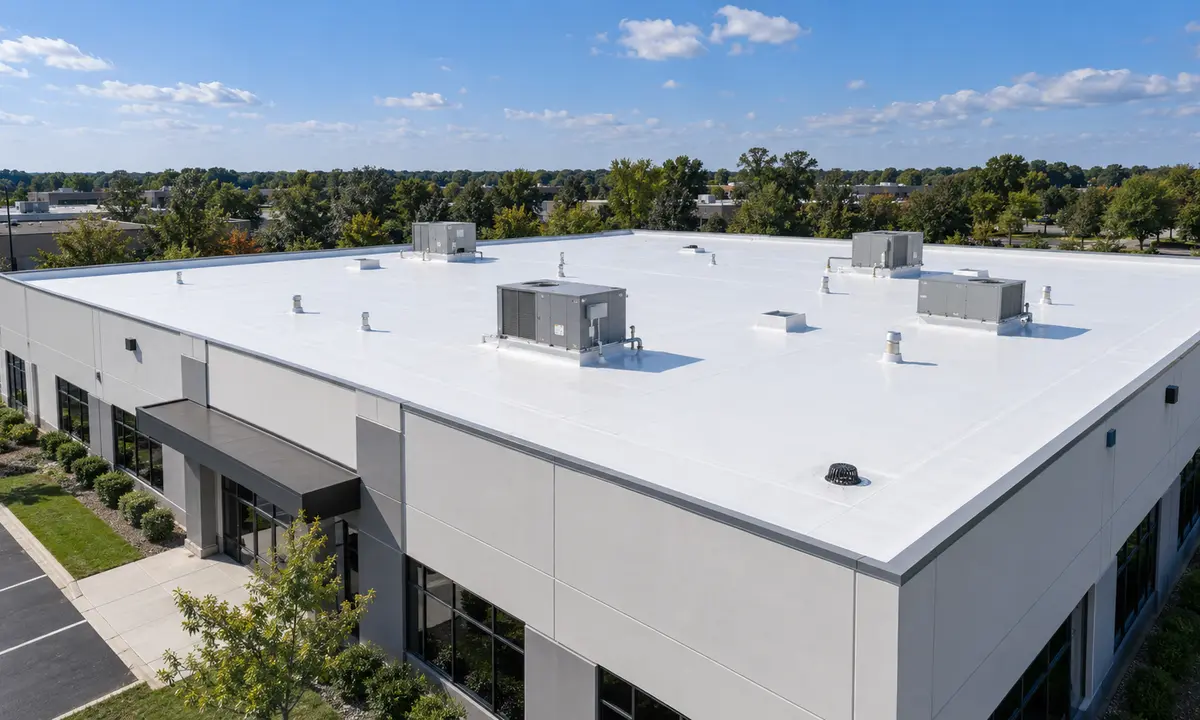
Evaluate the whole TPO roof assembly.
TPO is a thermoplastic single-ply roofing membrane with heat-welded seams. It is used on many commercial flat and low-slope roofs. Selecting TPO is only one part of a project: the substrate, insulation, attachment, perimeter details, and drainage also shape the finished roof.
TPO roof leak repairs
We investigate punctures, open welds, curb and pipe flashing, roof edges, and drain details. Existing membrane condition and previous repairs affect preparation and repair options. Repairs must use compatible products and procedures for the selected system; TPO and PVC should not be treated as interchangeable materials.
Where a heat-welded repair is appropriate, surface preparation and weld quality matter. Manufacturer guidance includes checking welded seams for deficiencies. See Carlisle’s roof inspection guidance for examples of system details that require review.
What to compare in a TPO replacement proposal
- Existing roof: layers to remove or retain, substrate condition, and investigation of suspected wet components.
- Insulation and coverboard: type, thickness, attachment, and whether slope or drainage work is included.
- Membrane: specified product, thickness, reinforcement or backing where applicable, and attachment method.
- Flashings and edges: curbs, pipes, walls, terminations, perimeter metal, and transitions to other roof systems.
- Building operations: staging, roof access, work areas, equipment coordination, and temporary protection.
- Coverage: the exact workmanship and manufacturer warranty options, eligibility, and exclusions.
Adhered or mechanically attached?
Attachment should be selected for the building and approved assembly. An adhered membrane and a mechanically attached membrane have different installation requirements; the deck, substrate, wind design, and manufacturer specifications affect selection. A proposal should identify how each roof component is secured instead of describing the project only as “a TPO roof.”
Can TPO be installed over the existing roof?
A recover may be considered when the existing assembly and applicable requirements allow it. Existing layers, moisture, substrate condition, loading, attachment, and system eligibility need review. Wet or unsuitable components require a defined solution; a new membrane does not make those conditions disappear.
Our repair, recover, and replacement comparison explains the decision points. The commercial roof cost guide helps compare the scopes behind competing totals.
TPO service across Central Indiana
RedCorn works with commercial owners and property managers in Indianapolis and surrounding communities. Share the address, roof size if known, current concerns, and decision timeline. For an existing leak, review our commercial repair process. For an ongoing plan, see commercial roof maintenance.
Common questions
Can an older TPO roof be repaired?
Localized damage may be repairable when the surrounding membrane and underlying assembly are serviceable. Weathering, contamination, previous repairs, and the ability to make a suitable repair affect the recommendation.
Is thicker TPO always the best choice?
Thickness is one specification to compare. The complete assembly, building use, substrate, attachment, flashing, and proposed warranty also matter. Ask for the full system scope.
Will a white TPO roof lower my energy bill?
A reflective roof can reduce solar heat absorption, but building energy costs also depend on insulation, HVAC, occupancy, and climate. Savings should not be promised from membrane color alone.
What warranty comes with a TPO roof?
Coverage depends on the specified products, eligible assembly, installation and inspection requirements, and the parties issuing the warranty. We identify the coverage available for the proposed project rather than assuming every roof qualifies for the same warranty.