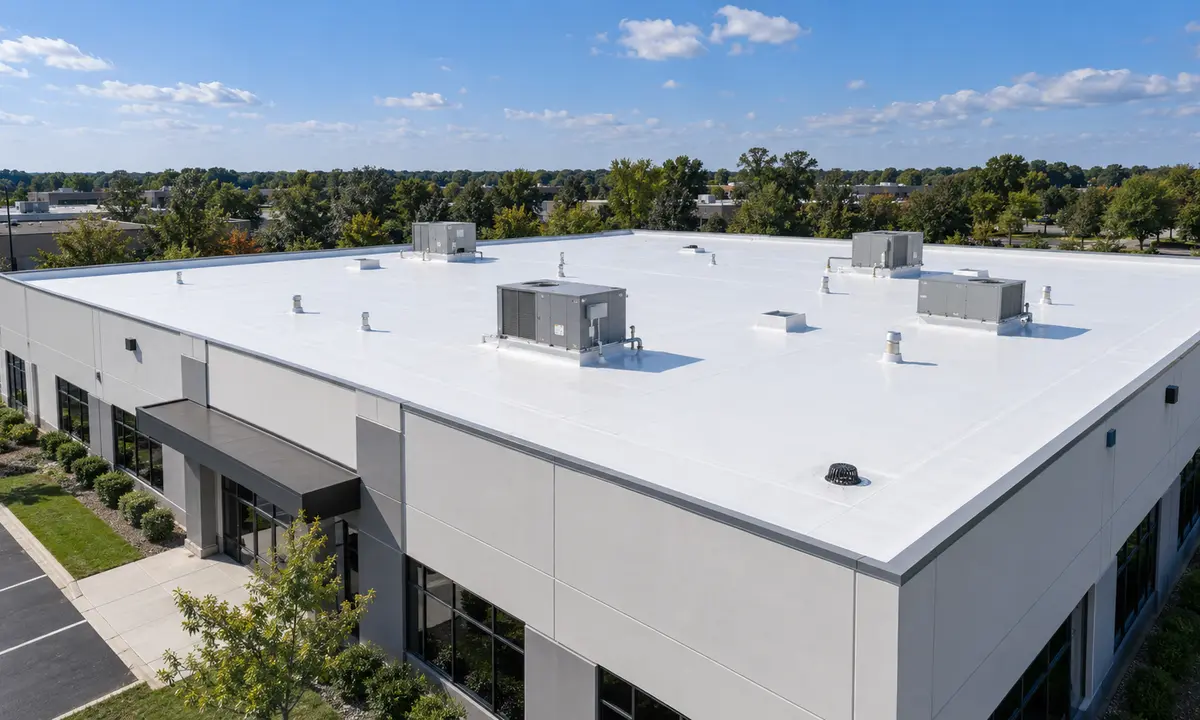
Compare the same roof and the same scope.
Commercial roofing cost depends on the existing assembly, the work required, and access to the building. Roof area alone cannot establish a reliable project price. A repair, a recover over a suitable assembly, and a full tear-off address different conditions and should not be compared as equivalent work.
The items that change a commercial roof price
- Roof area and geometry: measured area, perimeter length, separate roof levels, and the number of details. One roofing square equals 100 square feet.
- Existing assembly: the number and type of layers to remove, disposal, wet insulation, and damaged decking.
- New assembly: membrane type and thickness, insulation, coverboard, attachment, and required accessories.
- Drainage: tapered insulation, drain or scupper work, and related flashing.
- Penetrations and edges: HVAC curbs, pipes, walls, skylights, coping, and edge metal.
- Access and logistics: height, staging space, lifting equipment, occupied areas, and work-hour restrictions.
- Coverage and closeout: eligible warranty specifications, required inspections, and documentation.
Why a repair has a different cost structure
A localized repair includes more than the patch material. Investigation, travel, safe access, preparation, compatible accessories, and labor can account for much of the scope. Several defects or complicated flashing details change the work even when the affected roof area is small.
Describe the problem and roof history when requesting a commercial repair assessment. The resulting scope should identify the defects being addressed and any unresolved concerns.
Recover versus tear-off
A recover can avoid some removal work when the existing assembly is suitable and the applicable requirements allow it. It still needs a complete scope for substrate preparation, insulation or coverboard, attachment, flashing, and edges. A tear-off scope addresses the components designated for removal and allows those areas to be assessed as work progresses.
Existing moisture or unsuitable components may change the option available. Compare the conditions behind repair, restoration, recover, and replacement before using price alone to choose.
A bid comparison checklist
| Item | What to compare |
|---|---|
| Removal | Exact roof areas and layers removed or retained; disposal included. |
| Assembly | Product, thickness, insulation, coverboard, and attachment method. |
| Details | Edges, curbs, penetrations, drains, and transitions included in the price. |
| Unknown conditions | Investigation, allowances or unit prices, and written change authorization. |
| Operations | Access, staging, temporary protection, cleanup, and equipment coordination. |
| Warranty | Issuer, coverage, exclusions, eligibility, and maintenance obligations. |
Prepare for a useful budget conversation
Send the address, approximate size if known, existing roof records, photos you already have, and your timeline. Identify whether you need a repair proposal, a replacement budget, or a comparison of options. Use the commercial roof assessment checklist to gather the relevant information.
RedCorn Roofing provides written scopes for commercial properties in Indianapolis and Central Indiana. For system-specific details, review TPO roofing and EPDM repairs.
Common questions
Can you quote commercial roofing by square foot?
A unit price is meaningful only when the included assembly, quantities, details, and exclusions are defined. We review property conditions before providing project pricing.
Why are two roofing bids so different?
They may include different removal, insulation, attachment, flashing, drainage, access, or warranty scopes. Ask each contractor to identify those items and explain allowances before comparing totals.
Does this guide provide a price estimate?
No. It identifies cost factors and questions for a proposal. A project estimate requires a defined scope based on the building and roof conditions.