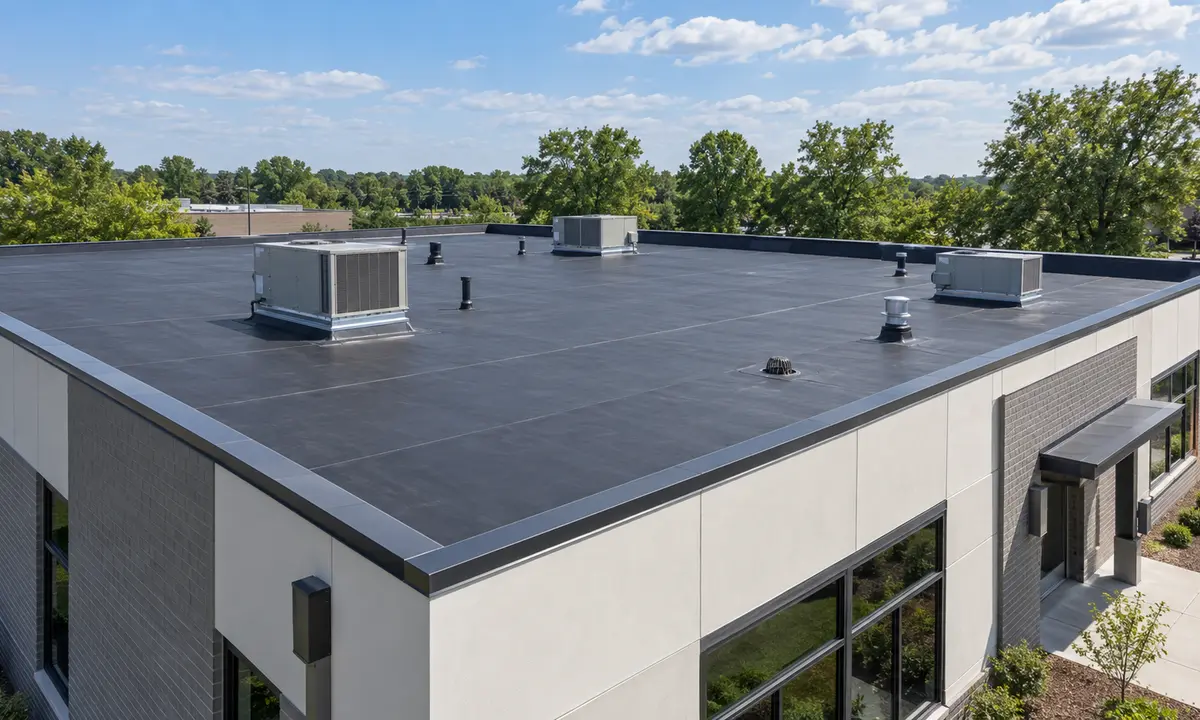
A rubber roof repair starts with the detail.
EPDM is a synthetic rubber roofing membrane commonly used on flat and low-slope buildings. A leak does not automatically mean the entire roof needs replacement. The condition of the surrounding membrane, insulation, attachment, and flashing determines whether a focused repair is appropriate.
Seams, patches, and damaged membrane
An EPDM repair assessment considers open laps, lifted patch edges, punctures, contamination, and movement around the defect. The repair needs a suitable surrounding surface and compatible materials. Previously applied coatings or sealants may affect what can bond and how much preparation is needed.
The proposal should identify the areas being repaired, how existing failed material will be handled, and which conditions remain outside the scope. If the surrounding assembly is wet or deteriorated, covering the surface alone will not address those components.
HVAC curbs, pipes, and wall flashing
Changes in direction create details that deserve close attention. We review curb corners, flashing laps, pipe penetrations, terminations, and signs of tension or separation. A leak near equipment may involve roof flashing, the equipment itself, or an adjoining wall; the investigation should distinguish these possibilities.
Cured cover strips, formable flashing, primers, and other accessories serve different purposes. Product selection and installation follow the applicable system detail. Carlisle’s adhesive and primer information explains why compatibility matters.
What your EPDM repair scope should address
- Affected roof sections and the observed defects.
- Surface preparation and compatible repair materials.
- Flashing, seams, terminations, and nearby details included in the work.
- Any additional investigation needed for concealed moisture or damaged components.
- Access, scheduling, exclusions, and the coverage offered for the repair.
Repair or replace an aging rubber roof?
Roof age is useful background, but condition drives the recommendation. An isolated defect on a serviceable roof may be repairable. Distributed failures, repeated repairs, or deterioration beneath the membrane can justify evaluating replacement. We explain the observed findings and the limitations of each option.
Review commercial repair and replacement options or plan ongoing roof inspections and maintenance.
Request an EPDM roof assessment
Send the property location, leak history, and roof or warranty records if available. We serve Indianapolis and surrounding communities including Speedway, Carmel, Fishers, Greenwood, Avon, and Brownsburg. For an active leak, call to discuss current availability. Visit our commercial roof repair page for the assessment process.
Common questions
Can you repair an EPDM seam without replacing the roof?
A localized seam defect may be repairable when the surrounding membrane and assembly are serviceable. Preparation, compatible materials, movement, and the extent of the failure must be assessed first.
Can any roofing tape be used on EPDM?
No. The tape, primer, flashing, and preparation must suit the membrane and the specific detail. Existing coatings or contamination can affect adhesion. Follow the selected manufacturer’s requirements.
Why does an EPDM curb keep leaking after repairs?
Possible causes include failed flashing laps or corners, tension at transitions, inadequate preparation, or an entry point in nearby equipment or walls. Reviewing the entire detail and leak history is more useful than repeatedly covering the same visible spot.
Will a repair preserve my existing roof warranty?
That must be checked with the warrantor. Provide the warranty before work so notification, approval, and contractor requirements can be confirmed.